
The Immersive Digital Experiences Alliance (IDEA) released its first draft specification of the Immersive Technology Media Format (ITMF) on October 9th, 2019 at Display Summit Conference, hosted this year by CableLabs in Louisville, Colorado.
To give attendees a preview of the display-agnostic possibilities of the format, a series of demonstrations were created by Charter Communications and CableLabs engineers with the support of IDEA founding members. These new demonstrations of the ITMF standard were conducted over two days – October 8th and 9th at the same venue.
For the first-ever demonstrations, a set of ITMF image files was created, and then rendered into different display devices, including VR, stereoscopic and volumetric displays. The ITMF file included 3D models, textures, cameras and a wide variety of parameters within the scene graph of the file. In addition, multiple render targets were used to designate individual display profiles.
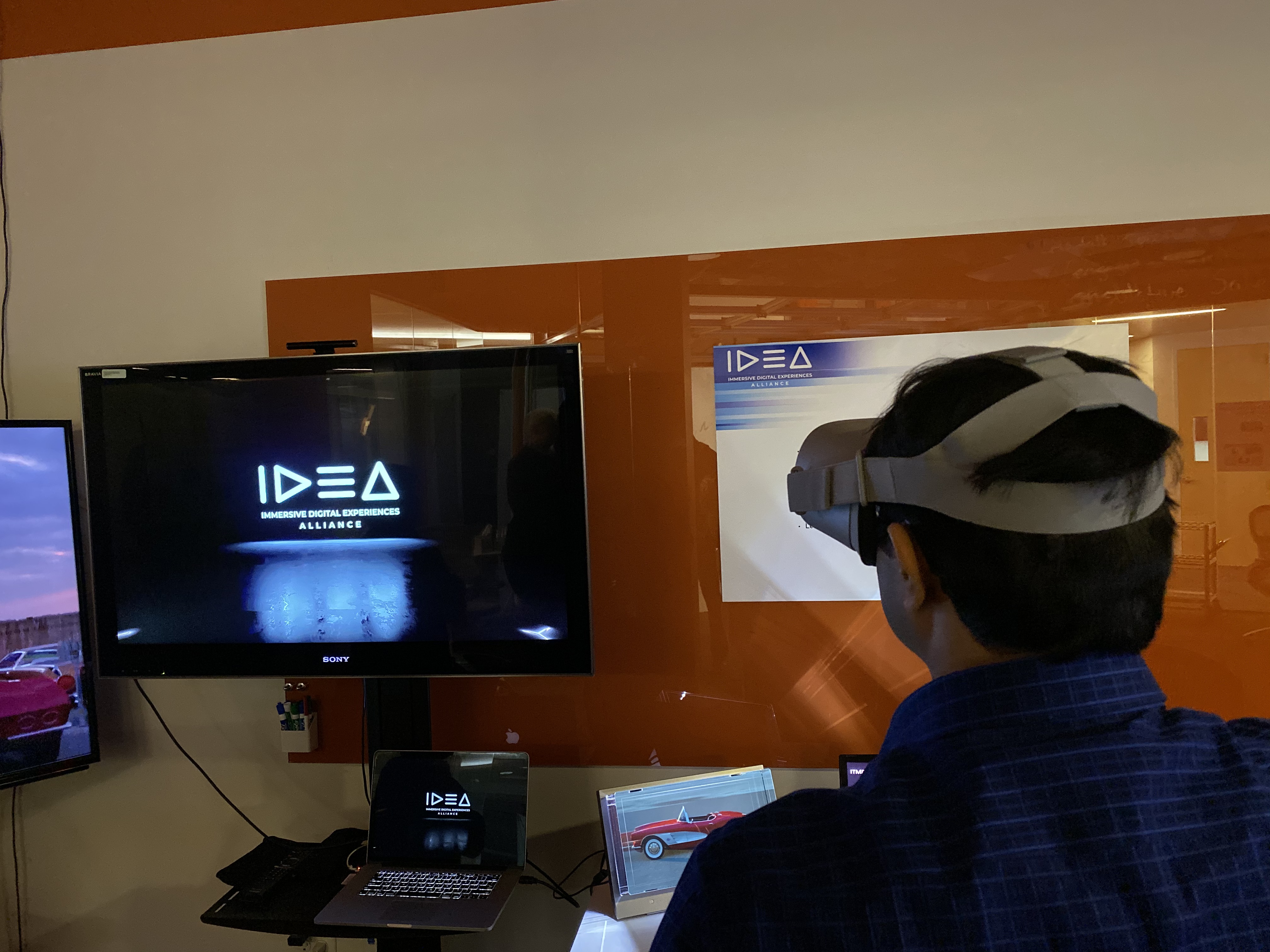
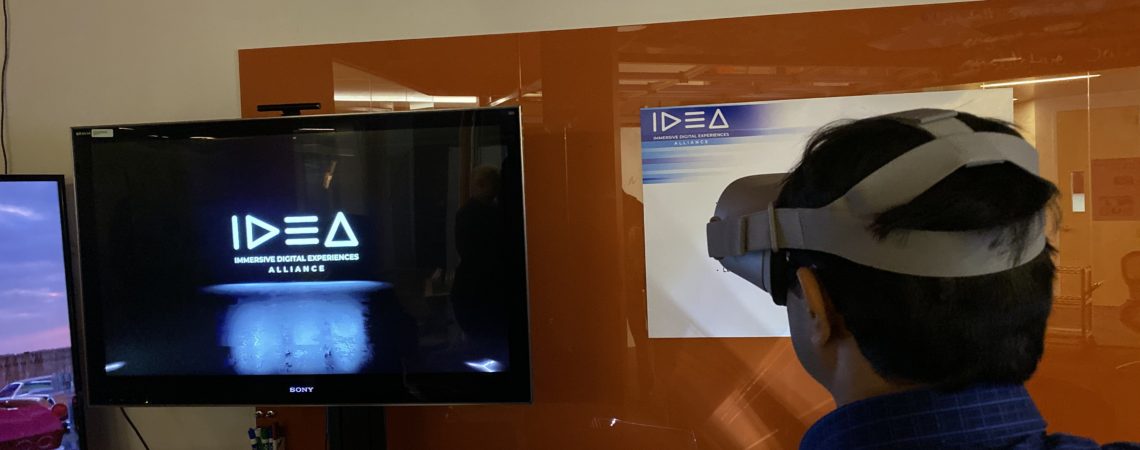
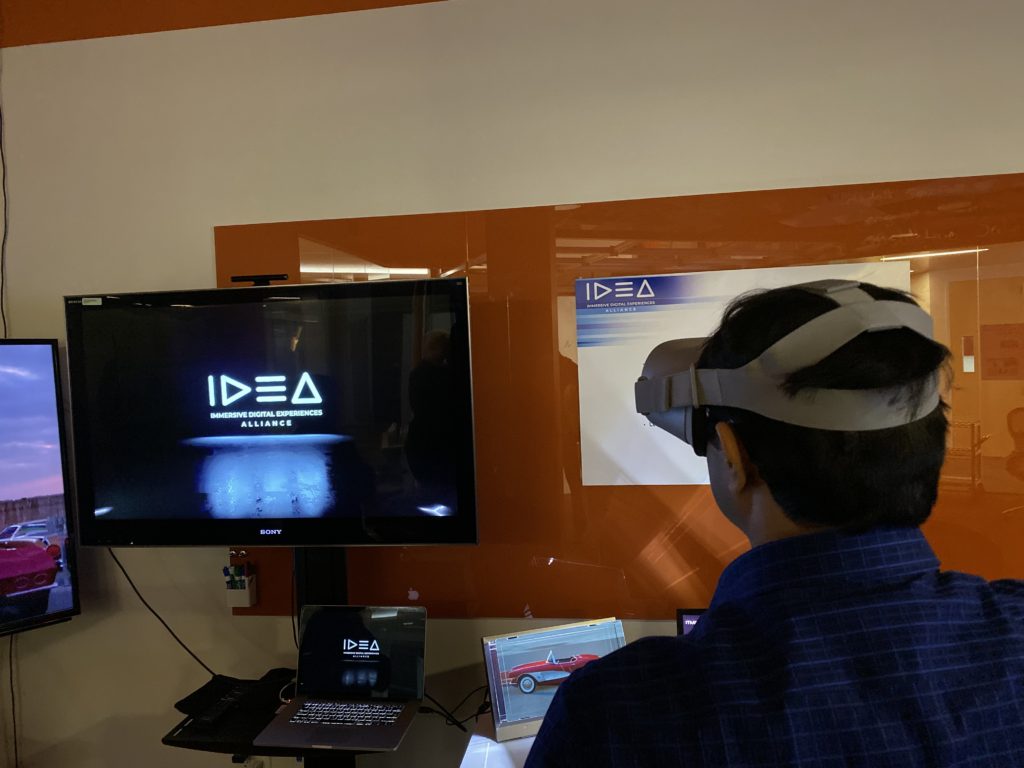
Demonstrations of ITMF running multiple display types at the Display Summit
As part of the demonstration an Oculus based VR Head-Mounted Display (HMD) was used to show three (11 second) stereo cube map animations, each with a resolution of 18,432 x 1536 pixels. These high-res animations represented different movie theaters and time periods to illustrate the progression of technology in media delivery. All were rendered using the OctaneRender unbiased render engine from OTOY, a founding member of IDEA, and supplier of the ORBX format upon which the release of ITMF is based. This was complimented by a video showing future uses of the ITMF format using XR based devices.
In addition, an HD 2D display and HD 3D TV video was created from the same ITMF file. Adding to this demonstration of the interoperability of the ITMF format, a Looking Glass Factory volumetric display was showing a 3D rendering of 42 different views from a camera setting and render target within the ITMF file itself.
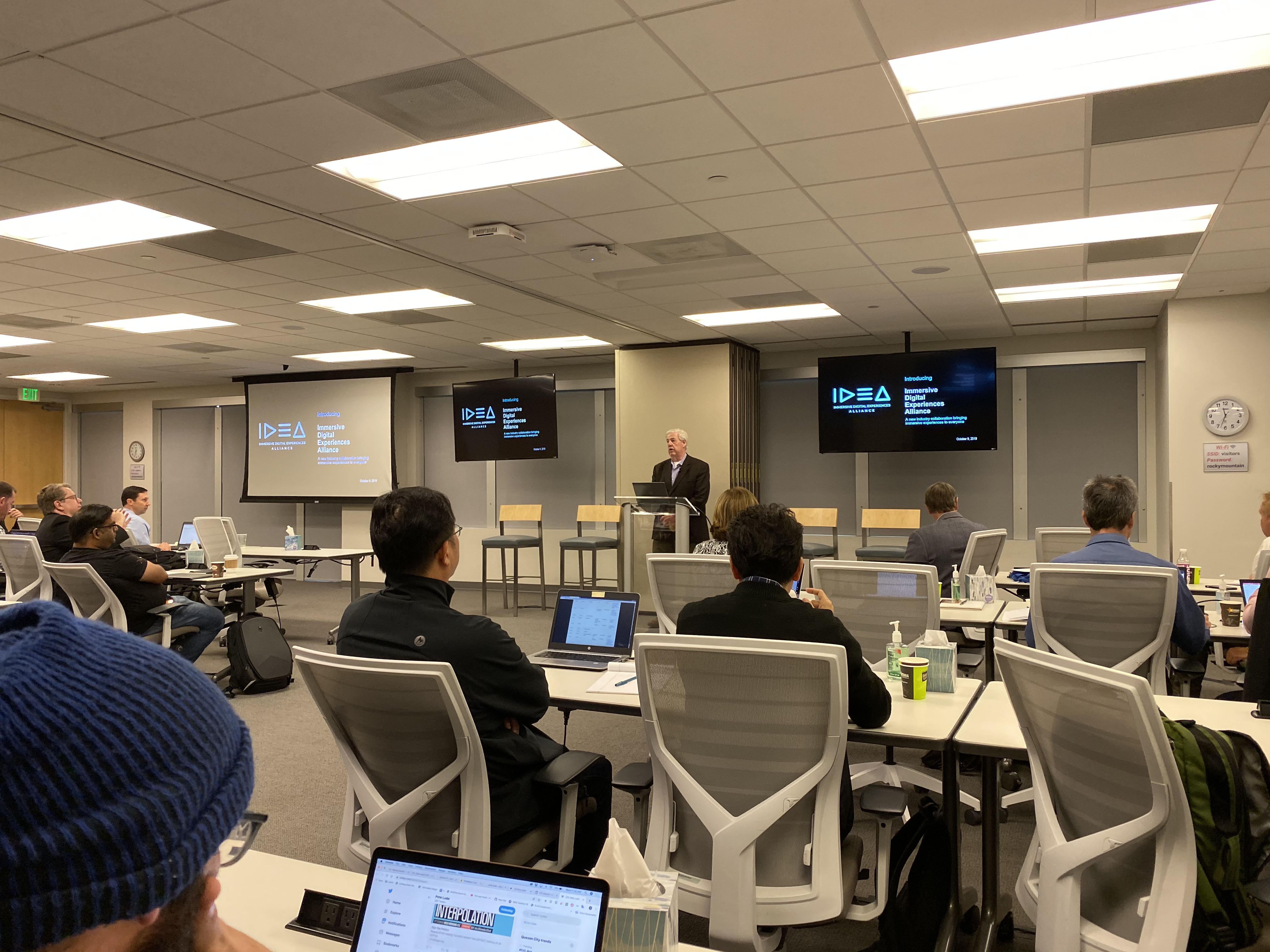
Pete Lude, IDEA chair and the October announcement of the ITMF draft specification
On hand to demo and showcase the future integration of light field imaging into the ITMF specification were Light Field Labs and Visby, both founding members of the IDEA Alliance. Demonstrations included playback of pre-recorded Light Field footage captured using a large camera array and image processing software from Visby. Representatives of Light Field Lab explained the how light field displays operate, using an example of the Mirascope as an optical analogy of the concept.
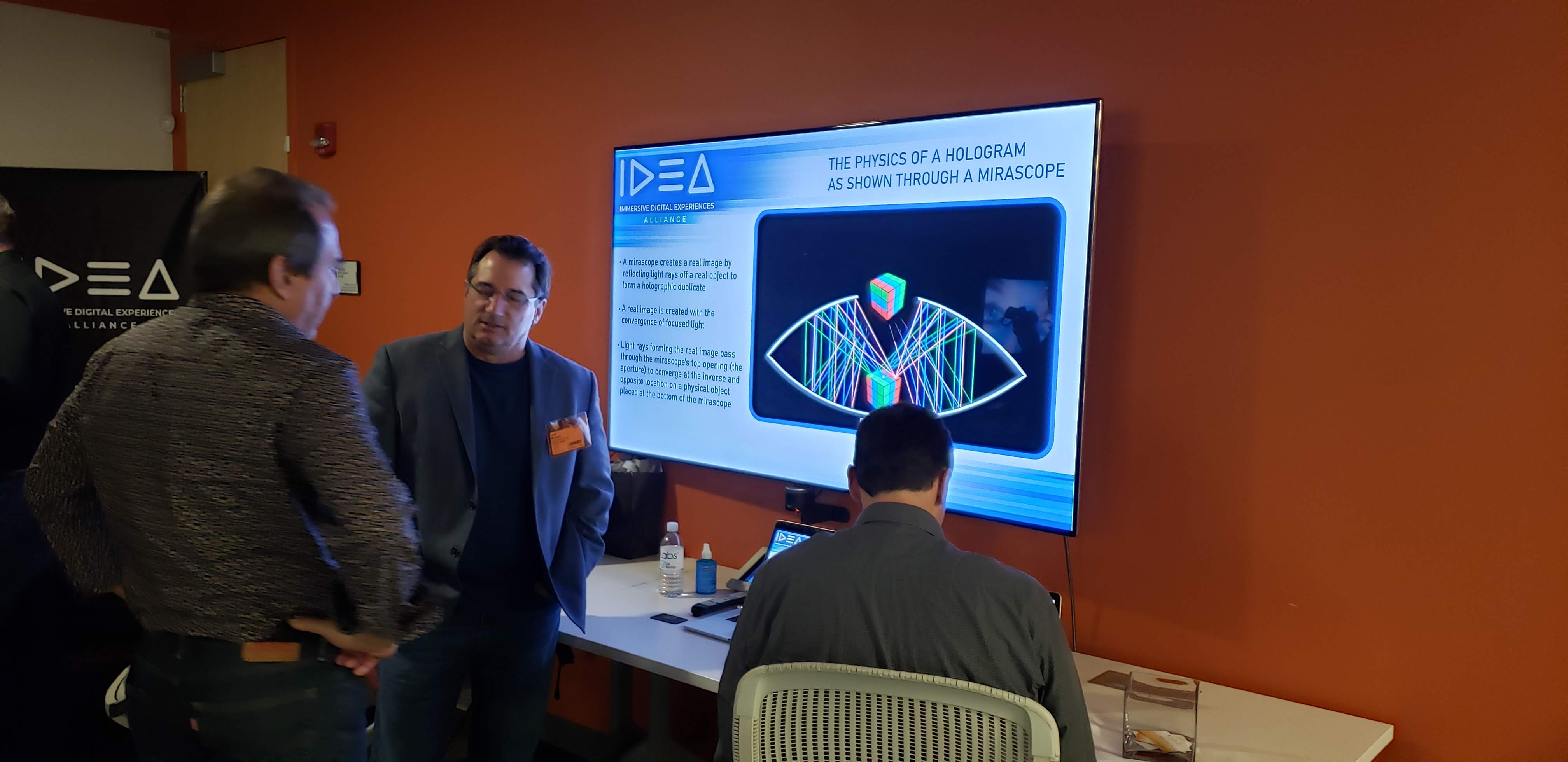
Light Field Lab demonstrating the physics of a Hologram as shown through a Mirascope.
Representatives from the Emerging Platforms and Technologies group within Charter Communications, another IDEA founding member, were also on hand to explain how media aware networks, rendering, streaming and delivery would be possible using the ITMF format.
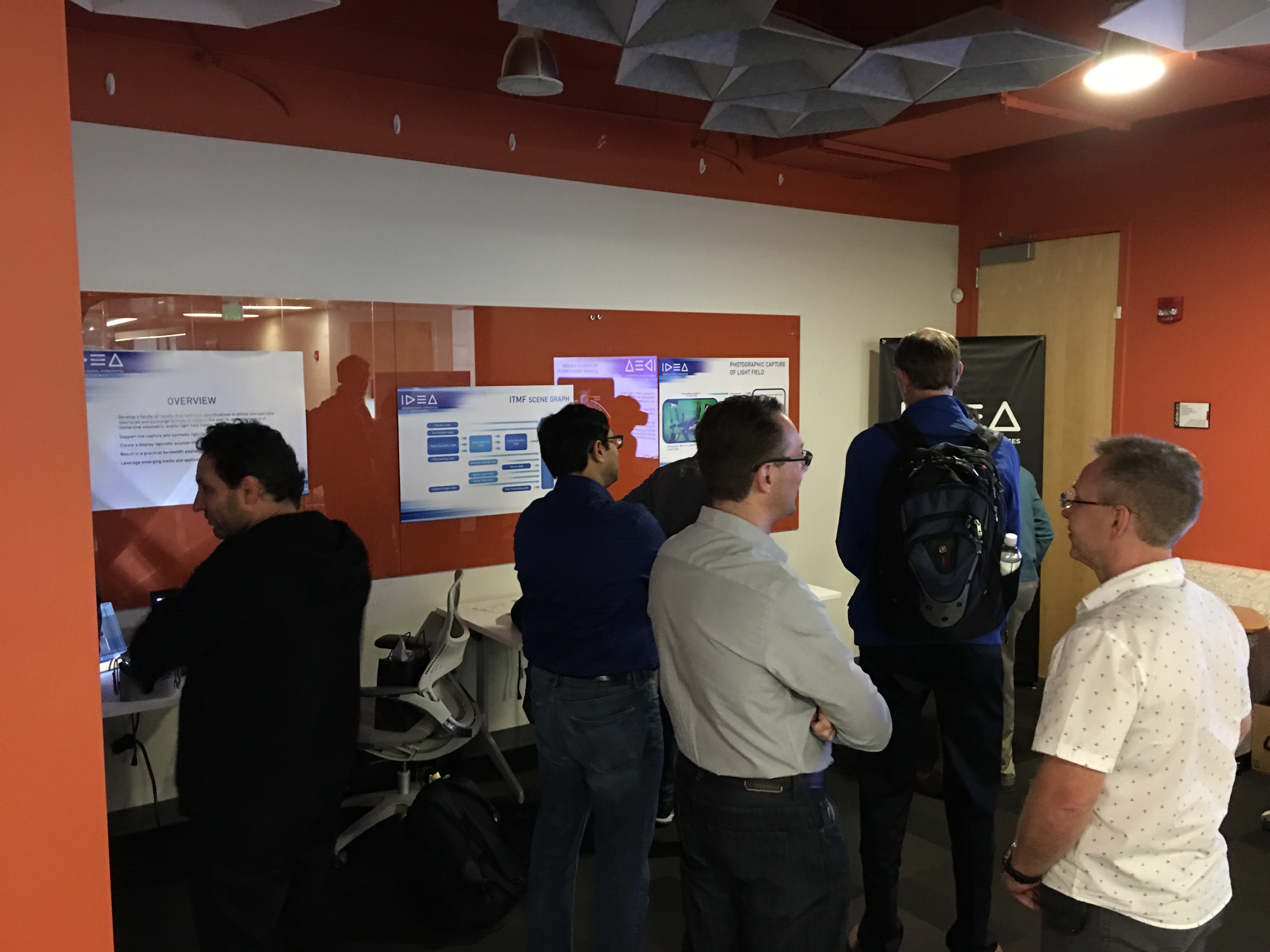
Members of IDEA and attendees discuss the ITMF format and immersive media delivery
Nearly 100 industry experts attended the ITMF demo over the two-day period, with copious questions and spirited discussions about the future of immersive imaging, and the role that ITMF is expected to play. Based on the enthusiastic response, IDEA is now beginning to plan for future demonstrations of immersive file interchange, and educational events to explain the ITMF specification in more detail. Be sure to join our mail list to keep posted on these upcoming events.
Designed to Streamline Delivery of Complex Imagery to Immersive Media Displays Over Commercial Networks, New Immersive Technology Media Format™ (ITMF) to Be Highlighted at Display Summit Conference
BOTHELL, Wash. — Oct. 9, 2019 — The Immersive Digital Experiences Alliance™ (IDEA) today announced the release of the first draft of royalty-free specifications for the Immersive Technology Media Format (ITMF). ITMF is a display-agnostic interchange format for conveying high-quality and complex image scenes to a wide variety of immersive displays, including extended-reality headsets and display panels, based on the highly anticipated light field technology.
Signalling industry momentum for immersive technologies, IDEA is releasing the first set of ITMF specifications only six months after the alliance made its debut at the 2019 NAB Show. IDEA is staging the first-ever demonstration of applications based on ITMF at the Light Field and Holographic Display Summit taking place today and tomorrow at CableLabs® in Louisville, Colorado.
The ITMF specification is based on ORBX® scene graph technology, a format created by OTOY and now supported by dozens of software systems used in 3D animation and game development. Starting with the ORBX scene graph format, ITMF is designed as an interchange and distribution format for conveying high-quality, complex image scenes to immersive media displays over commercial networks. Applications range from passive viewing, gaming, and telepresence, including six degrees-of-freedom (6DoF), to next-generation light field displays. Recognized for its potential to deliver an immersive, true-to-life experience, light field is now considered the richest and most dense form of visual media, thereby setting the highest bar for features that the ITMF will need to support and the new media-aware processing capabilities that commercial networks must deliver.
The initial ITMF suite includes three documents: a scene graph specification, a container specification, and a data encoding specification. The scene graph specification describes the physical attributes of a scene or object in mathematical terms and then provides instructions for the complex computational machinery at the receive end to generate the image.
“IDEA came together in response to the growing momentum for immersive media — a viewing experience that goes beyond the constraints of a flat screen and rectangular picture to ‘immerse’ the user in the scene. Advances such as AR/VR and 3D have approached this concept, but until now there’s been no common framework to enable these types of images to be transmitted on a commercial network and viewed on any device,” said Pete Ludé, chairman of IDEA and consultant to CableLabs. “We’re a few years away from realizing that goal, but ITMF is supercharging the effort. And IDEA is doing it without reinventing the wheel, by leveraging innovative and field-proven tools and technologies from the computer graphics world, such as ORBX.”
While not fully implemented in the initial draft, the goals for the ITMF specification are based on on five key attributes:
- The unique ability to achieve a fully immersive image, based on the best possible image representations and with light field technology as the highest common denominator.
- Solutions that are practical for transmission, with the ability to transmit complex data to viewers’ homes without using an inordinate amount of bandwidth.
- Display-agnostic solutions that support any type of display or viewing device, ranging from smartphones and extended-reality headsets to home theaters and expansive cinematic displays at entertainment complexes and theme parks.
- Support for media-aware networks to optimize delivery with available network bandwidth and support of different display devices, enabling deployment of new immersive services.
- An open and royalty-free interchange format that any vendor can access and implement, thus spurring a broad range of industry solutions and speeding adoption.
At the Light Field and Holographic Display Summit, IDEA will present proof-of-concept media based on the new set of ITMF specifications and displayed on multiple devices, including a 3D TV, a VR headset, a 2D display, and a volumetric display. The new specifications are now available for public comment on the IDEA website at www.ImmersiveAlliance.org.
About IDEA
The Immersive Digital Experiences Alliance (IDEA) is a non-profit industry alliance working towards developing a family of royalty-free technical specifications that define interoperable interfaces and exchange formats to support the end-to-end conveyance of immersive volumetric and/or light field media. An alliance created by CableLabs, Charter Communications, Light Field Lab Inc, OTOY, and Visby, IDEA brings together like-minded technology, infrastructure, and creative innovators working to develop an end-to-end ecosystem for the capture, distribution, and display of immersive media. More information is available at www.ImmersiveAlliance.org.
Link to Word Doc: www.wallstcom.com/IDEA/191009IDEA.docx
Photo Link: www.wallstcom.com/IDEA/IDEAlogo.jpg

Photo Caption: IDEA Logo
| IDEA Marketing Contact: Jessy Lynn Marketing for IDEA Tel: +1 425 293 3700 Email: jessy@ImmersiveAlliance.org |
Agency Contact: Chris Lesieutre Wall Street Communications Tel: +1 503 610 0842 Email: cles@wallstcom.com |
2019 Light Field and Holographic Display Summit
October 8-9, @ the CableLabs facility, Louisville, Colorado
IDEA will be presenting examples of the ITMF specification running on a wide variety of display systems at the 2019 Light Field and Holographic Display Summit. This is the first public showing of the specification showcasing the interoperability and robust feature set ITMF provides for creation and delivery of current and future media types. Multiple display types will be running content created directly based on the specification.
Attendees will have a chance to see up close how the ITMF format fits into the 2D, 3D, and immersive ecosystems and networks.
Members of IDEA will be on hand to answer questions and walk attendees through the specification. It will be an excellent opportunity to discover how developers, content distributors and media providers can use the ITMF specification to their advantage.
October 8-9, @ the CableLabs facility, Louisville, Colorado
During the two-day event the focus will be on the latest developments in the light field and holographic ecosystem – from capture to display. Hosted at CableLabs, the R&D arm of the international cable industry, attendees will be able to get a tour of the facility and see special demos curated for the event. CableLabs is also a founding member of the Immersive Digital Experiences Alliance (IDEA), a group of like-minded technology, infrastructure and creative innovators preparing for the future of media for entertainment.
Attendees will be able to attend presentations on a wide variety of topics including:
– Light field or holographic Overview talks
– Light Field and Volumetric Capture
– Spatial computing
– Formatting and Distribution (broadband, 5G, Wi-Fi)
– Rendering
– Advanced Displays
– Multi-planar
– Light Field
– 3D
– Volumetric
– Holographic
End User Needs and Perspectives:
Military, defense, security, AR/VR, automotive, medical, consumer, theme parks, planetariums, museums, design, simulation
Concurrent with the event the Immersive Digital Experiences Alliance (IDEA) will have a major announcement and be presenting a series of demos focusing on the ITMF specification.
To learn more or register for the event, click here.